
 By Allen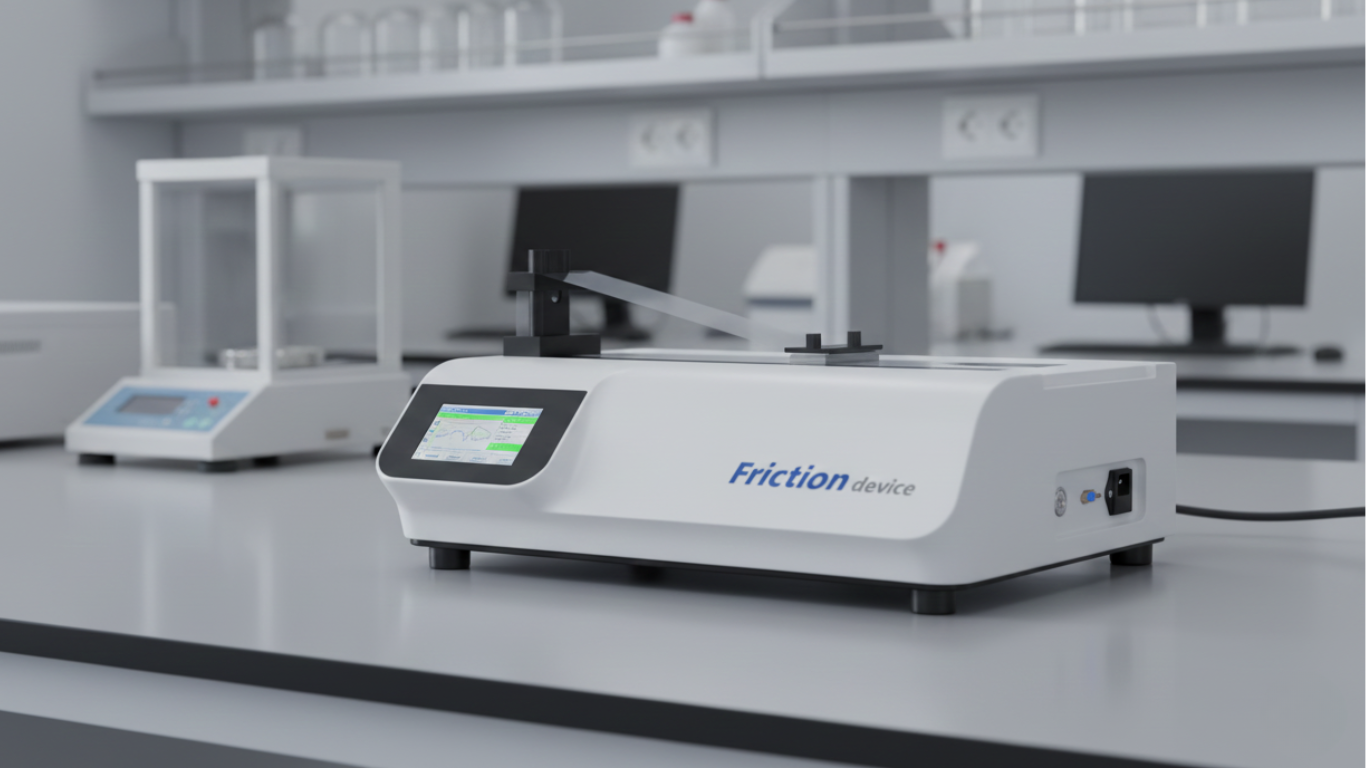
The coefficient of friction tester is a fundamental instrument in quality control, crucial for quantifying the interaction between two surfaces. In industries ranging from flexible packaging to automotive, the resistance a material exhibits when sliding against itself or another surface directly affects product safety, manufacturing throughput, and shipping stability. If the friction is too high, material jams; if it is too low, stacked goods slip.
This comprehensive guide details the science behind the measurements, the required procedures, and the vital role of coefficient of friction testing in mitigating costly failures in production and logistics.
The Science of Slip: Static vs. Kinetic Friction
Any coefficient of friction test determines the ratio of the force required to move one surface over another to the force pressing the two surfaces together (the normal force, or weight). The result is a dimensionless ratio. This analysis yields two distinct and critical values:
1. Static Coefficient of Friction (COF-S)
The Static Coefficient of Friction (COF-S) represents the force required to initiate motion between two surfaces that are at rest (the force needed to break the initial adhesion). This value is essential for stability.
For instance, a high COF-S is needed between stacked bags or boxes to ensure they do not immediately shift when a pallet is moved. If COF-S is too low, the packaging is prone to sliding, which results in damaged cargo and safety hazards.
2. Kinetic Coefficient of Friction (COF-K)
The Kinetic Coefficient of Friction (COF-K) is the average force required to sustain motion once the surfaces are sliding. This value is critical for flow. Low COF-K ensures that packaging film slides smoothly over rollers, forming collars, and conveyor belts.
If the COF-K is too high, friction causes heat buildup, slows line speeds, and leads to costly machinery jams.
The coefficient of friction tester provides these values by using a precisely weighted sled and measuring the force required to pull it across a stationary test surface.
The Standard Method: ASTM D1894 and Quality Control
Accuracy in friction measurement depends entirely on adhering to a controlled coefficient of friction test method. The most common standard globally for plastics and packaging films is the ASTM D1894 coefficient of friction test (Standard Test Method for Static and Kinetic Coefficients of Friction of Plastic Film and Sheeting). Adherence to this standard is non-negotiable for supply chain verification and quality assurance.
Following this rigorous coefficient of friction test procedure ensures that factors like sled weight, speed of travel, and test environment (temperature and humidity) are consistent, making results comparable across labs and supply chains.
Detailed Coefficient of Friction Test Procedure
The typical coefficient of friction test equipment uses a motorized plane and a calibrated sled connected to a sensitive load cell. The equipment itself is constructed to minimize vibrations and ensure the pull is uniform and level.
- Conditioning: Both the sample material and the test environment must be conditioned. ASTM standards typically require samples to be stabilized at 23 degrees Celsius (plus or minus 2 degrees C) and 50% relative humidity for a specified period (e.g., 40 hours). This ensures that absorbed moisture, which drastically affects the COF of materials like paper and textiles, is stabilized. Failure to condition correctly is a common source of error.
- Setup and Mounting: Cut the test material (e.g., plastic film or paperboard) into specified dimensions. Affix the test sample to the motorized plane and wrap the mating sample around the sled.
- The Sled and Load Cell: The standard sled typically weighs 200 grams or 1,000 grams. The sled is connected to the load cell via a flexible, inextensible filament (often a thin string or nylon wire) to ensure that the measured force is applied horizontally. The load cell must be highly sensitive to accurately capture the momentary spike in force when COF-S is overcome.
- Dwell Time: The sled is placed on the sample and allowed to “dwell” for a specific period (usually 15 seconds). This ensures proper surface contact and allows any electrostatic charges to dissipate before measurement begins.
- Initiation: The motorized plane begins to move at a uniform, specified rate (often 150 mm/min for ASTM D1894).
- Measurement: The load cell records the peak force required to overcome initial sticking Fstatic and then records the average sustained force during sliding Fkinetic. This latter part of the curve is crucial for calculating a stable COF-K value, which should be averaged over a significant sliding distance.
- Calculation: The software within the coefficient of friction testing equipment calculates the COF by dividing the recorded force (F) by the weight of the sled (W). For reliable reporting, multiple tests (e.g., five repetitions) must be performed, and the results averaged, often including rotation of the samples to test both machine direction (MD) and transverse direction (TD).
Preventing Failure: Why COF Testing is Essential
A. Packaging Throughput and Efficiency
If the COF-K of a film is too high, it will resist sliding along forming tubes and sealing jaws, leading to manufacturing jams, increased wear on machinery, and slow line speeds. Conversely, if the COF-K is too low, materials may slip out of position, causing sealing errors.
Precision coefficient of friction testing enables manufacturers to set and maintain the narrow range of COF needed for optimum high-speed packaging. For instance, film used in vertical form-fill-seal (VFFS) machines typically requires a COF around 0.2 to 0.4 for smooth operation.
B. Pallet Stability and Shipping
The COF-S between layers of material on a pallet dictates its stability. If the friction is too low (e.g., COF-S < 0.3), the stacked goods are prone to shifting or sliding off during shipping, resulting in damaged cargo.
A sufficiently high COF-S ensures that the layers grip each other, maintaining structural integrity throughout the shipping and handling process, minimizing the need for excessive stretch wrap or strapping.
C. Specialized Applications in Engineering
The utility of coefficient of friction test equipment extends far beyond packaging. Highly customized test equipment coefficient of friction between tie plate and crosstie is used in the railroad industry.
This specific application measures the friction between the steel plate supporting the rail and the wooden or concrete sleeper below. This data is vital for designing rail systems that withstand immense forces and resist lateral movement, ensuring track stability and safety under heavy load.
Troubleshooting and Ensuring Data Accuracy
Even the most advanced coefficient of friction tester can yield inaccurate results if proper protocols are not followed. Addressing these common issues is crucial for reliable data.
1. Contamination and Edge Effects
A common mistake is surface contamination. Fingerprints, residual cleaning solvents, or dust particles left on the sample can drastically alter the COF. Always handle samples by the edges and clean the test plane before each run. Furthermore, if the sample strips are cut poorly, rough edges can cause binding, leading to false high COF-K readings.
2. Static Charge and Humidity
Testing plastic films often generates static electricity, which can cause the samples to stick unnaturally, resulting in artificially high COF-S readings. As per standard guidelines, maintaining controlled humidity (50% RH) in the testing environment is essential to dissipate static and provide the most accurate coefficient of friction testing equipment performance.
3. Equipment Alignment
The force applied by the coefficient of friction tester must be perfectly level and uniform. If the machine’s pull speed is inconsistent or the pull cable is not parallel to the test surface, the measured force will be compromised. Regular maintenance and calibration checks are necessary to verify the load cell accuracy and motor speed.
Selecting the Right Equipment
When choosing coefficient of friction testing equipment, consider automation and compliance.
- Automation: Modern automated systems eliminate operator subjectivity during the peak force detection and speed up the coefficient of friction testing process significantly.
- Compliance: Verify that the coefficient of friction test equipment adheres strictly to ASTM D1894 and relevant ISO standards. Certification documentation is vital for audits.
- Versatility: Look for a device that can accommodate different test fixtures (e.g., specialized sleds for different weights) and has the capacity to handle large, rigid samples in addition to flexible films, maximizing its utility in a comprehensive QC lab.
Final Thoughts
The coefficient of friction tester is a critical tool for quality assurance, providing predictive data that ensures everything from a single roll of plastic film to an entire pallet of finished goods performs as expected.
By mastering the standardized coefficient of friction test and its underlying principles, engineers and quality managers maintain tight control over material flow, production efficiency, and supply chain safety, ultimately reducing waste and liability.
Do you need reliable coefficient of friction test equipment that complies with global standards? Visit Qualitest or WorldofTest website to explore our range of advanced coefficient of friction tester designed for precision and automation across all materials, from packaging films to specialized industrial components.