
 By Ch Umar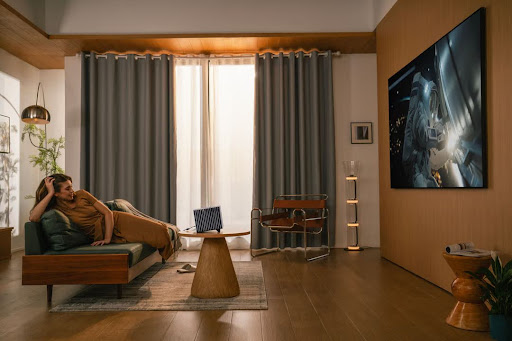
I have moved apartments four times in the last six years. It is a rite of passage for city living. And every single time, the absolute worst part of the move—worse than the mattress, worse than the boxes of books—was the television.
Trying to maneuver a fragile, 65-inch sheet of glass into a tiny elevator, or worse, pivoting it around a narrow pre-war stairwell, is a nightmare. And once you finally get it into your new 600-square-foot studio, you realize it dominates the entire room. You have to arrange your sofa, your dining table, and your life around this black monolith.
For a long time, I assumed this was just the price of admission for high-quality entertainment. If you wanted a cinematic experience, you needed a massive TV, and you needed to sacrifice your floor plan to accommodate it.
But recently, that logic has broken down. The rise of high-performance, compact projection technology is changing the rules for renters and small-space dwellers. It turns out, the best way to get a massive screen in a tiny apartment isn’t to buy a bigger TV—it’s to get rid of the TV entirely.
Here is how to build a 100-inch theater that fits in a backpack, keeps your landlord happy, and transforms your shoebox apartment into a penthouse cinema.
The Myth of “Throw Distance”
The most common misconception about projectors is that you need a deep, cavernous basement to use one. People hear “projector” and think they need 15 feet of distance between the lens and the wall to get a decent image.
Ten years ago, that was true. Today, it’s history.
Modern optical engineering has revolutionized “throw ratios.” This is just a fancy term for how far back the projector needs to sit. Today’s versatile long-throw and lifestyle units are equipped with incredible zoom lenses. You can often get a crystal-clear, 100-inch image from just 8 or 9 feet away—roughly the distance from a coffee table to the wall in a standard living room.
If you are really tight on space, “Short Throw” technology exists, but even standard premium projectors now fit comfortably into typical city layouts. This means you don’t need a dedicated media room. Your living room wall, or even your bedroom ceiling, is enough.
The “Pop-Up” Cinema: Flexibility is King
The beauty of apartment living is adaptability. Your dining table is also your desk. Your living room is also your yoga studio. A giant TV fights against this versatility because it is anchored to one spot.
A projector, however, flows with your life.
Imagine this: It’s Tuesday night. You have friends coming over for a movie marathon. You set the projector on the coffee table, pull down a lightweight screen (or just use a clear white wall), and suddenly you have a cinema that spans your entire field of view.
Then, the movie ends. You turn it off, put the projector in a drawer or leave it on a shelf as a stylish object, and your wall is blank again. You have reclaimed your space.
When you are looking for the best 4k projector for city living, this portability is the killer feature. You aren’t buying a piece of furniture; you are buying an experience that you can pack up and take with you. If you move next year, you don’t need to hire specialized movers for your screen. You just put it in your bag.
The Bedroom Revolution
Let’s be honest: having a TV in the bedroom is controversial. Some say it ruins sleep hygiene; others say it’s ugly. But we all secretly love watching a series in bed on a rainy Sunday.
This is where projection wins again. Instead of bolting a screen to the wall opposite your bed (which looks like a hotel room), you can place a projector on a bedside table or a high shelf.
Because modern units are compact and run quietly, they are perfect for intimate spaces. Some setups even allow for ceiling projection. Lying flat on your back, watching a nature documentary or a starry sky projected directly onto the ceiling above you, is an experience a TV simply cannot replicate. It feels less like “watching television” and more like an art installation.
Solving the Sound and Light Problem
“But what about the windows?”
This is the second biggest objection. Apartments have windows, and city lights never really go out. Can a projector handle ambient light?
The answer lies in the lumens and the laser. Old bulb projectors were dim. New RGB laser models are light cannons. While direct sunlight will wash out any image (even an OLED), modern laser projectors are bright enough to punch through the ambient light of a city evening. You don’t need blackout curtains to watch The Office after work.
As for sound, you have neighbors. You can’t install a thumping subwoofer on the third floor without getting an eviction notice.
Fortunately, the best movie projector models on the market today come with integrated sound systems that are shockingly good. We aren’t talking about tinny laptop speakers. Many feature tuned audio by brands like JBL or Harman Kardon, delivering rich, clear dialogue without the floor-shaking bass that travels through walls. Alternatively, almost all modern units feature Bluetooth 5.3, allowing you to pair high-quality noise-canceling headphones for a truly immersive experience that won’t wake the baby next door.
The Renter-Friendly Upgrade
Finally, we have to talk about installation. Landlords hate holes in walls. Mounting a heavy TV bracket often requires drilling into studs, leaving behind damage that eats into your security deposit.
A projector requires zero structural commitment.
You can place it on a bookshelf. You can put it on a tripod stand that tucks behind the sofa. You can sit it on a stack of art books on the coffee table. The “Auto-Keystone” and “Auto-Focus” features found in premium models mean that even if you place it at a weird angle, the AI will snap the picture into a perfect rectangle instantly.
Conclusion: Living Large in a Small Box
Living in the city means making compromises. We trade space for location. We trade quiet for culture. But we shouldn’t have to trade quality entertainment for square footage.
By ditching the traditional TV setup and embracing the flexibility of laser projection, you can maximize every inch of your apartment. You get the 100-inch screen you always wanted, without the black monolith you always hated. It is the ultimate hack for modern, urban living.